Tuesday, 14 July 2015

What goes on tour

When I arrived at Glenfarclas, the plan was that I would spend 4 months learning about the processes involved in making whisky, while trying to make myself useful....or at least not get in the way.

As I have written previously, I spent time filling casks and rolling them around in warehouses, making vast quantities of flat beer in the mash house and trying to learn the black art of distillation. Even the boring bits were interesting in one way or another, and I was amazed at how the patiently everyone showed me their craft and made me feel welcome. It is clear that the people who work at Glenfarclas take pride in what they do and the whisky that is produced.

The end of my 4 months was approaching all too quickly and I was by no means ready to leave. This was an industry that had finally captured my interest, in a country that I was rapidly falling in love with.

While I was working in production, I was told the Glenfarclas Visitor Centre would be hiring an additional tour guide to assist with the extra visitors to the distillery over the busy summer period. I applied for the job and given that I had undeniably relevant experience, was the successful applicant.

Of the roughly 50 distilleries in the Speyside region, Glenfarclas is one of the minority that is set up to take visitors who want to see the whisky-making process and absorb a bit of the "water of life" mystique. Glenfarclas has a visitor centre with lots of wood and tartan and a tasting room with panelling that was salvaged from the first class smoking lounge of a pre-WWI steam ship. For most of the year, there are four part-time tour guides who take visitors on tours of the distillery and talk about a bit of the history and background. The guides also run the visitor centre shop.

The Visitor Centre

My training as a tour guide was to follow the other guides around on a few tours and to "familiarise" myself with the Glenfarclas range of whiskies. I soon started taking tours myself and with each tour, my explanations get a bit more polished. The challenge is to tell the same joke several times a day and make it sound fresh each time. I have been taking tours for about 2 months now and it's the best job of all. People who come to the distillery are generally on holiday and in a good mood. I talk to them about something I am interested in, then feed them booze. It doesn't really feel like work at all.

The Visitor Centre operates in a jovial and slightly haphazard way where nothing is taken too seriously. It all makes for a very enjoyable working day. Most other distilleries hire students as tour guides over summer, but at present, I am the youngest of the six guides and the only full-timer. The others are all good fun and while the days are busy, we seem to spend the spare moments laughing about one thing or another. There is absolutely no pressure to sell as the Visitor Centre is there more as a public relations exercise than to sell whisky. If people leave the distillery with a good impression of the place, the people and the product, then we have done our job. If they like the whisky and want to buy a bottle or some sort of souvenir, then we are happy to oblige.

Whatever I am saying here clearly isn't interesting enough to hold one man's attention

Each tour is different. 12 people is about the most I like to have on a tour, but last week I took a tour of 43 German high school kids. Sometimes it's just one or two people on the tour and it ends up being a chat and a stroll around. People come in from all over the world. Some stereotypes have been shattered, others reinforced. The Germans are often very serious until the mood is lightened with some toilet humour. A Japanese man came in recently and I offered him a taste of a special Glenfarclas. He must have enjoyed it because as he sat and sipped it, he made the most obscene, almost sexual groans. Tour buses can be a tough crowd, mostly as they are only there because their tour of Scotland includes a distillery, and not all of them are that interested. Whisky nerds are an peculiar bunch and like to try and catch the guides out. I have the advantage of having worked in whisky production, so can answer most of their ridiculous questions. The vast majority of the visitors are great and I often feel like I form hour-long friendships.

"Over to your right, you will notice....."

I don't really like the whole business of selling things, but I decided to set myself a challenge to sell whisky without coming across as a salesman. This has turned out to be quite enjoyable. I have become a massive Glenfarclas fan-boy, so I will quite happily tell someone how special a certain bottle is and what a comparative bargain it is. They soon realise that not buying this bottle would be extremely regrettable. In fact, perhaps the sensible option is to get two...

I have moved into a cottage in the country, just outside of the village of Dufftown, which calls itself the "Malt Whisky Capital of the World". I'm growing to like Dufftown. I'm making friends and getting involved in some community activities. There is a Stramash (traditional live music night) on Mondays, a whisky tasting hosted by a different distillery every Wednesday night and a Ceilidh (traditional Scottish dancing night) every Thursday. My friend Denny from the Netherlands is a guide at another distillery and has also recently moved to Dufftown. We met at one of the whisky tastings and hit it off. He and I can usually be found at any local event where there is whisky involved. I even hosted one of the whisky tastings on behalf of Glenfarclas, which was a new (and slightly daunting) experience, but good fun.

My new hoose. Consider this an invitation to come and stay. It's not as grand as the last one, but it does have a spare room.


In September, as the long days become shorter, the tourists will become fewer and the need for an extra guide will decrease. My stint as a guide, like all good things, will come to an end. In the mean time, I will learn all I can and build as many relationships as possible. I would love to stay in the industry, but who knows what the future holds.

"This whisky is of such superior quality, it will even cure male-pattern baldness"

Wednesday, 3 June 2015

How to make whisky - the other bits

In previous blog entries, I've outlined the processes for making and maturing whisky.

A few weeks ago, I had the opportunity to go on a field trip to visit a couple of the businesses that provide Glenfarclas with products and services essential to the running of the distillery.

Production Manager, Callum and I drove about an hour north of Glenfarclas to the Boortmalt maltings near the industrial seaside town of Buckie. Boortmalt buys barley from farmers in the North-East of Scotland, germinates it and dries it out using hot air from a gas-fired kiln to halt germination. The germination process converts the starch in the barley to sugar, intended to be a food source for the new growth. The germinated and dried barley is called malt. It is the sugar in the malt that is extracted and fermented to make whisky.

In years gone by, distilleries would malt their own barley. Where Glenfarclas now stands, was once a farm called Rechlerich and distilling was very much a secondary exercise. It was quite common for a farm to have a small (and often illegal) distillery on the premises. Whisky making was seen as an effective way of using any surplus barley.

Glenfarclas malted its own barley until the late 1960's, when the quantities of malt required by the distillery could no longer be produced on site.

Boortmalt supply malt to a number of distilleries in the Speyside region, including a significant proportion of the 100+ tons of malt delivered to Glenfarclas every week. No peat is burned in the kilning process, so Glenfarclas has very little of the smokiness that is commonly associated with whisky from Islay and the west coast of Scotland.

Barley is harvested in late summer, so Boormalt has capacity to store thousands of tons of un-malted barley, ready to be malted and delivered to distilleries.

A  mountain of barley ready to be steeped, germinated and kilned.

The first stage of the malting process is known as steeping, this is where barley is soaked with water in order to increase the moisture content from around 14% to 45% and start the germination process.  


This not-particularly-good photograph is of the barley during the germination process. Humidified air is blown through the  grain bed and the grain is slowly turned with big corkscrews to prevent matting and maintain air flow.
This barley has been germinated and is about ready for kilning. Kilning involves drying the grain to around 4-5% moisture by blowing large volumes of hot air through the grain, The shoots in this photo shrivel up and drop off in the kilning process. It is only the sugar in the grain that distillers are interested in.
Don't think about the millions of little plant-abortions that occurred so that you could enjoy a dram.

A truck delivers 28 tons of malt to Glenfarclas. We get 4 or 5 of these trucks every week.

On the way home from the maltings, Callum and I dropped in on Forsyths Engineering in the town of Rothes, which is around 15 minutes from Glenfarclas.

Forsyths are engineers to the distilling industry the world over. Their primary product is custom-made copper stills for the distillation of spirits.

I have already discussed the purpose and operation of stills. Having operated the stills at Glenfarclas, it was fascinating to see new stills under construction.

Stills are made from copper because:
a) it is soft and therefore much easier to work than stainless steel
b) it conducts heat evenly
c) copper acts as a catalyst to remove sulphur-based compounds from the alcohol that would leave unpleasant flavours in the whisky. The idea is to have the spirit in contact with copper as much as possible.
Forsyths make each still to suit the requirements of the distillery. The volume will suit the size of the of the vessels used to for fermentation and the production volumes. The size of the still for the first distillation is usually larger than that for the second one. The shape of the still has a significant influence on the finished product, with a taller, narrower still making a lighter-tasting spirit and a lower, squatter still producing a heavier one.

The coppersmiths at Forsyths have been making stills since the late 1800's, and many of the techniques used are much the same as they always have been. We were shown into the main coppersmitthing workshop, where the sounds of hammering are overwhelming. A still starts life as sheets of 5mm-thick copper, which are hammered by hand and by a planishing hammer, into compound curves. These are then gas-welded together, with all the welds having to be hammered as they cool.

The elegant swan-neck at the top of the still starts life as four flat pieces, cut out on a water-jet cutter. When finished, it is a seamless, complex shape. Copper costs about £7000 a ton, and a finished still can cost a distillery as much as £100,000. A skilled coppersmith is well-rewarded for his craft.
With all the heat cycles and wear, a still lasts about 25 years. With over a hundred distilleries in Scotland, and many more around the world, Forsyths have got a waiting list of about 2 years. Earlier this year, they built and delivered stills for a new distillery being built in Cardrona, New Zealand.
A coppersmith uses a template and a wooden mallet to shape part of a still.
The lower part of a still under construction

Completed stills ready for shipping. These are going to a new distillery in Glasgow.

The inside of a condenser. The spirit flows through the narrow copper tubes, surrounded by a water-jacket of cold water, fed from a nearby stream or "burn" as a stream is called in Scotland.

Wednesday, 15 April 2015

How to make whisky - Part 2

A couple of weeks ago, I started learning the role of the Stillman, ie. the guy that operates the stills.

The Stillman takes the wash that was made in Part 1, and uses it to make the spirit that will become whisky after a period of maturation.

Glenfarclas has 6 stills: 3 wash stills and 3 spirit stills.


A still is a large, bulbous vessel made from copper. 25,000  litres of wash (the "beer" from Part 1) is pumped into the wash still, until it comes up to just above the widest point of the still. A gas fire is lit underneath the still and the alcohol in the wash starts to evaporate, along with some of the water. The alcohol and water vapours rise up to the top of the still, around a tight bend and outside to a condenser. The condenser cools the vapours, turning them back into a liquid. This liquid is called "Low wines". It is roughly 20% alcohol and gets piped into a holding tank.

The low wines from the holding tank are then pumped into a spirit still. The spirit still takes around 20,000 litres, and the process starts again. As the still heats up, the alcohol begins to turn to vapour. The alcohol that vapourises at the lowest temperature (around 58 degrees celcius) is a mixture of Methanol and Acetone. These are "bad alcohols", the the ones that cause blindness and death.

Needless to say, blindness and death are undesirable charateristics in whisky, so the stillman lets this flow back into the holding tank to be mixed with low wines and distilled again. After running for 20 minutes, the liquid coming off the still is usually 63 - 70% ethanol, which is the alcohol we know and love. It is referred to as "spirit" at this point and goes into a tank, ready to go into a cask. The spirit flows for about 7 hours, before the alcohol is mostly evaporated. The stillman redirects the weaker liquid that is now coming from the still, known as "feints" back into a tank with the low wines and the "bad alcohols", to be distilled again.

All this is contorolled with rather Steampunk-looking windowed brass box called a Spirit Safe. All the liquid that comes off the stills runs through the Spirit Safe and allows the Stillman to see that the liquid is flowing and lets him take a sample of that liqid at any time in the process to measure the temperature and alcohol levels, and control the swap from feints to spirit and back again.

Checking the gravity and temperature of spirit in the spirit safe
Traditionally, a Spirit Safe was securely padlocked, with the keys held by Customs & Excise. This was so spirit couldn't be syphoned off and consumed without having had the appropriate taxes paid on it. These days, the keys are held by the distillery and we are trusted to play by the book. With modern technology, a spirit safe isn't strictly necessary, but it looks the part, so most distilleries still have them.

If you go on a distillery tour, the tour guide will often refer to the "head", the "heart" and the "tail" when describing the distilling process. The head being the "bad alcohols", the heart being the spirit that becomes whisky, and the tail being the weaker liquid that gets distilled again.
This is the whisky you'll be drinking in your old age, running through the spirit safe
After all the precious alcohol has been distilled off, you are essentially left with dirty water in the bottom of the the still. In the wash still, this is called "Pot ale". In the spirit still, it is "Spent lees". The pot ale is heated to reduce and thicken it and is sold to farmers as a high-protein syrup to feed livestock. It can also be mixed with the draff, left over from the mash process to make animal feed pellets. The spent lees gets filtered and pumps back into the water system.

There are 3 Stillmen, and they each work five 8-hour shifts a week, from Sunday night, until Friday afternoon, with Friday usually devoted to cleaning. The job is a little bit of chemistry, a little bit of physics and a whole lot of watching the clock. Each process and sub-process has an expected time that it will take, so the Stillman always needs to be aware of what is going to happen next and when.

Thursday, 19 March 2015

How to make whisky - Part 1

Whisky is made as follows:
  • Obtain malted barley (barley that has been allowed to germinate, then toasted to stop the germination process).
  • Grind it up to release the sugars.
  • Add this, with hot water and liquid yeast, to the mash tun. The mash tun is essentially a 60-something-thousand litre teapot. The ground malted barley (referred to as "malt") steeps in this water , then all the water is slowly drained off into a wash back with some yeast. A wash back is the fermentation tank. 
  • More hot water (known as the 2nd water) is added to the malt, much like getting a second brew out of your tea bag, and this water is also drained into the wash back. Before it has fermented, this liquid is referred to as "wort". The lid is shut on the wash back and the wort is left to ferment until most of the sugars have been turned to alcohol. This takes roughly 48 hours.
  • A 3rd water is pumped onto the malt, then pumped back into a holding tank. This will be used as the 1st water for the next brew(!). The leftover spent grain is known as draff. This is pushed out of the mash tun by mechanical arms and augers. It gets taken away by truck and turned into animal feed.
  • After fermentation, you are left with what is essentially a weak, un-hopped beer, still full of half-dead yeasts. On my first day at Glenfarclas, the Production Manager, Callum said to me "You can drink this. You can get drunk on it, but it WILL put you on the toilet for 2 days".
  • That beer, known as "wash" is then pumped to the distillation area to be refined into spirit and put into casks (more on this in another post).
The steps prior to distillation are known as "mashing" and they are controlled by a "Mashman". The "mash"  is the sweet porridgey mixture you get when ground malt and hot water are combined.
The Mashman has a computer screen that allows him to open and close a number of pneumatic valves to shift liquid around. He can see how much liquid has gone to where, what temperature it is and how long it has been there for. In addition to the pneumatic valves, there are plenty of manually operated valves. He is constantly checking the position of valves and the open drain channels to make sure precious liquid is not being sent to the wrong place, or down the drain. All the vessels have to be regularly pressure-hosed, then treated with bleach and hot steam to kill any bugs that could interfere with the next brew.

Mashing and distilling at Glenfarclas is a 24-hour operation, Monday to Friday. The Mashman works an 8-hour shift. In my first week of training, I was working with James on the 6am to 2pm shift. James has worked in whisky production at several distilleries in the area for 30 years, not that you would think it possible to look at him. On my first day, James explained to me he is essentially lazy, so sitting behind a computer, controlling the process suits him nicely. James's definition of lazy clearly differs from mine. He starts the shift at full-speed, checking that all the processes that were started in the previous shift are running as they should be and assesses what he will need to do over the next 8 hours. He goes and talks to the still operator to check that the distillation is running to schedule and establishes when he will need the next batch of wash for distilling.

Good loons: James the Mashman and John the Stillman (not a couple)

Whenever James instructs the computer to shift some liquid or malt around, he gets up and goes to check that it is happening and that there are no blockages or valves left in the wrong position. He is always thinking one step ahead, or doing something now, so it will help with the process later on in the day. He is constantly listening for noises that could indicate a problem, a pump running dry or a process ending. Meanwhile, he is managing the malt milling process for the next batch.

After doing this for a couple of hours, he can stop for a couple of minutes and enjoy a cup of tea (while still keeping a close eye and ear on everything). At any time, a truck could show up with a load of malt or to take away the draff, requiring him to co-ordinate the process. I think I could teach him a thing or two about lazy.

At the end of each week, the Mashman who is working on a Friday afternoon thoroughly cleans out the mash tun so it's ready to go when shifts start again the following Sunday night. Cleanliness is paramount to prevent an infection that could affect fermentation and write-off days worth of production and thousands of pounds in raw materials.

Matthew IN the mash tun
This week, I have been on night shift and it feels like I am getting my head around the process. There are so many valves (known as "Crans") that could be left open, resulting in thousands of precious litres going down drain. The shift is from 10pm to 6am. I'm slightly concerned that at 5am, my brain is not to be trusted with such risks. It can feel like a long night, but I have enjoyed the camaraderie between Mashmen and Stillman.

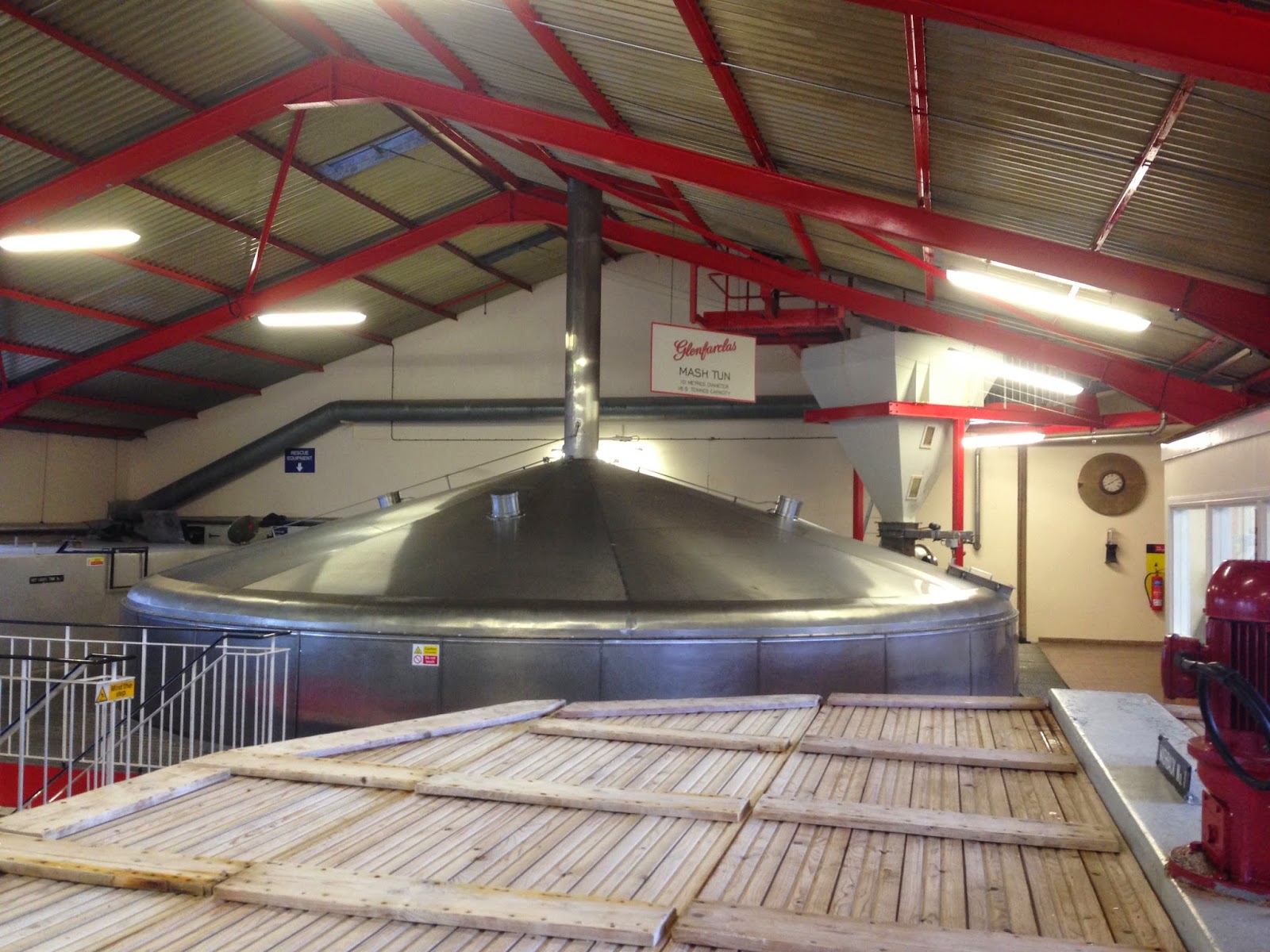
Glenfarclas has the largest mash tun in Scotland, at 10 metres in diameter.
The 12 wash backs. This is the upper storey of a two-storey building and the washbacks go almost to the ground, holding around 27,000 litres each.
My news is that Glenfarclas has decided to hire a tour guide to cover the busy season from April to September. I have been offered and accepted this role and start at the end of April. In the mean time, I've got another week of mashing, then 4 weeks learning the distillation process. If anyone wants to come and visit over summer, I'll be the one in the tartan trousers without a Scottish accent. Sadly, the house I'm staying in is needed for guests over summer, so I am on the look-out for my own, more modest accommodation in the area.

When not making whisky or sleeping, I've been exploring the area, visiting to the nearby towns and villages and doing lots of country walks. It feels very much like spring is here. The first bulbs are flowering, the days are getting longer. The squirrels, foxes and badgers will soon be snufflling around. I sometimes think I'm living in a mixture of Wind in the Willows and Monarch of the Glen.

I don't think I could be any happier.

“Take the Adventure, heed the call, now ere the irrevocable moment passes!’ ‘Tis but a banging of the door behind you, a blithesome step forward, and you are out of the old life and into the new! Then some day, some day long hence, jog home here if you will, when the cup has been drained and the play has been played, and sit down by your quiet river with a store of goodly memories for company.”
― Kenneth Grahame, The Wind in the Willows

Wednesday, 11 March 2015

Travels in the North-East of Scotland

Since getting my car, I have taken the opportunity do some sightseeing in the north-east of Scotland. I'm very glad I got it because there is some breathtaking scenery here, and some cracking driving roads. Here are some photos from my wandering.

The Tormore Distillery.
I am slightly obsessed with this grand building. Sadly the distillery is not open to the public, and they really only make average whisky to go into blends. I'm itching to see inside though, so one day soon, I might just wander in, then pretend I don't speak English when I am asked what I'm doing. It is about 10 minutes drive from Glenfarclas. I have driven past it several times, and each time I have to get out of the car to just look at it.


Highland coos

A pheasant, just waiting to be plucked

A few weeks ago, I went to the surprisingly beautiful and sandy beach at Lossiemouth and dipped a toe in the North Sea.
It wasn't that bad after my feet went numb from the cold.

You can't swing a jousting stick without hitting a castle up here. This is the ruin of Huntly Castle, and one of several I have visited. It's fascinating to see these buildings, some of which were started in the 1100's, then evolved over the next several hundred years and saw all sorts of dramas.
 
Roads like these, in an angry little Renault hot-hatch like mine: Heaven.

Scotland's coast is dotted with incredibly charming little fishing villages, like Stonehaven, pictured here. The harbours of these villages are mostly too small for large-scale commercial fishing boats, but there are still craft coming and going. In a village like this, you might see someone wearing a cable-knit jersey and a fisherman's cap....and they wouldn't even be a hipster.

Are you feeling lucky?

Thursday, 19 February 2015

Glenfarclas 1 month on - A collection of bad iphone photos.

It is a month today since I started at Glenfarclas. Here are a bunch of photos of things that have caught my eye in that time.

A whisky cask that was filled in 1957 and has just been hanging out, thinking about how delicious it's going to be, ever since.
I came across these two casks in a storage area and asked why they had bits of branch wrapped neatly around them. I was told this is commonly done with brandy and cognac casks (which these had once been). It is usually Willow saplings that are used, which is a much softer wood than the oak of the casks. The theory is that Woodworm will attack the softer wood and are less likely to bore into the oak, jeopardising the cask's contents.
My kind of smoked salmon
This is a 1950's "Green Goddess" Bedford fire engine that is owned by Glenfarclas. The story relaid to me is that it was bought because the insurance company offered a discount in the premiums if the distillery had it's own fire-fighting equipment. I think in reality it's just a big toy for the boys. I'm hoping to blag a drive in it, because my inner 3-year old would probably wet himself with excitement.
I found this Coventry Climax FWB fire pump engine (that goes with the Goddess above) sitting in one of the sheds. Vintage motorsport enthusiasts will be drooling. Normal people will be thinking "Eh....it's a grubby old fire pump engine that doesn't look like it's run in years."
In years gone by, the distillery would have owned cows that were fed on the spent grains from the mashing process. This is an old cheese press from those days.
The man on the right in this photo is Miguel. He has just spent 2 days driving his articulated lorry from Spain to deliver a load of fresh sherry casks for us to fill. The extent of his English is "Hello" and "OK", but he still managed to exchange some schoolboy banter with the aid of a wiggling little finger, ribald chuckling and references to chorizo.
There is an old farmhouse onsite that is now used for storage of equipment and supplies. This is the wallpaper from what undoubtedly was "the boy's room". Very Royal Tenenbaums.
I didn't so much find this at the distillery as buy it for £1600 and take it there myself. It is a 2003 Renault Clio 172 Cup and I adore it. It is a very small, light car with a powerful 2-litre engine that makes it hopeless in the snow. It breaks my heart to drive it on the heavily-salted Scottish roads.


Tuesday, 10 February 2015

The art of the Warehouseman

Monday morning came, and with a stomach full of porridge, I walked down to Callum's office to report for work. I was issued with a navy blue outfit and steel cap boots. A few introductions, then it was off to the filling room, where rows of freshly-stencilled, empty casks were waiting to be filled.

The filling room and warehouses are managed by a cheerful man called Tommy. Working alongside him are Euan, Brian and Brian's son Andrew. They all have a strong North-east Scottish accent and initially, I could understand about a quarter of what they were saying. . They have been patient with me though, and I'm picking up more and more:
"ken" means "know" (Do ye ken?)
"pesh" is "piss" (It's peshin' oot 'o this crack)
"loon" is "boy" or "son" (Gordon's loon was visiting last weekend)
"quine" is "girl"(Go and ask the quines in the office)
"piece" is a morning or afternoon tea snack (Have you got a piece to go with your cup of tea?)
"scutch" is  a wedge of wood that is jammed under a barrel to stop it rolling.

In the filling room is a 46,000 litre tank, that is constantly being filled with new spirit from the stills.
New spirit is clear like water, around 63% alcohol and tastes whisky-ish, but harsh and a bit fruity.

The job of the warehouseman is to:
  • Select empty casks that are stored around the distillery and take them to the filling shed.
  • Paint out any previous numbers from the end of cask.
  • Stencil new details onto the end of the cask.
  • Fill the cask with new spirit from the tank and record how much liquid went in.
  • Hammer a new poplar bung into the filling-hole of the cask
  • Sometimes the casks will leak from a crack in the wood, a woodworm-hole or from a bung that hasn't sealed properly. The warehouseman will hammer the steel hoops of the cask towards the fatter centre part of the cask, compressing the staves (planks of oak that make up  cask) to try and close any gaps. For a worm-hole, he would expand the hole with a nail then hammer in a small piece of dowel. If the leak is coming from around the disc of wood that seals the end of a cask, dried reeds called flagging will be jammed in  to try and seal it. No glue is used in the construction of the cask, it is all held together by the friction of the hoops. Sometimes the hoops rust or fall off and need to be replaced, so the warehouseman becomes a cooper and fits a new hoop with hand tools. If it's the bung that's leaking the bung hole will be reamed out and a larger bung fitted. If all this fails, the spirit will have to be decanted into another cask. It should be noted that you must never ask a warehouseman where the cask is leaking from. He will pause, look you in the eye and reply "probably from the inside".
  • The filled cask is then taken by forklift to one of the 34 warehouses Glenfarclas has on site.
  • The casks are stored on their sides, two or three high, depending on the size.
Casks vary in size from 200 litre ex-bourbon barrels, to 250 litre ex-sherry hogs-heads, referred to as  "hoggies", to 500 litre ex-sherry butts and 600 litre ex-port pipes, which is essentially a longer sherry butt. Glenfarclas is known for its sherried whiskies, so the bulk of the casks are ex-sherry casks from Spain and Portugal. A used 500 litre sherry butt is worth about £700, so the cask is a greater cost than the liquid that gets put into it. This also means that running repairs, as described above, sometimes need to be made to casks to get maximum use out of them. A cask is usually used 4 times, before being retired. The cask is a major contributor to the flavour and colour of a whisky as it matures. With each subsequent use, the influence of the cask becomes less.

I spend a lot of my day rolling these casks around in warehouses. The larger casks can weigh over half a ton when full. I have enjoyed learning various techniques minimise the effort required. Full casks always have to be stored, even for short periods, "bung up", ie with the bung facing upwards, as this is where the cask is mostly likely to leak from. This sounds easy enough, but when you are storing a dozen or so casks in a row on two wooden rails, some forethought is required. There is a whole clockface system where by you roll one cask into a stowe with the bung up as you start rolling, then the next cask will have the bung at "twenty past", the next at "twenty too", then "bung up" again.
It's not easy to explain, and I often get it wrong myself, but let me say that when a cask rolls along its wooden rails and thumps into place next to another cask, with the bung pointing straight up, that is job satisfaction right there!

I have the pleasure of spending much of my day in the warehouses where the casks are stored. There warehouses are  dimly-lit and filled with full whisky casks, stacked on their sides, two or three high in multiple rows. Most of the warehouses have an earth floor with a concrete path running down the middle. The warehousemen lay wooden rails about a foot apart on the earth perpendicular to the path. Casks are lined up on the rails, bung-up, until they stretch from the side wall of the warehouse to the path. The casks are carefully levelled by eye, and another set of rails is added on top of the first casks. A specially-designed lift is used to bring the next layer of casks, one-by-one, from the ground to the top of the casks below. If smaller casks are being stowed, a third set of rails and casks will be added on top. A scutch is used to stop a row casks from moving.

The most striking thing about the warehouses is the sweet, woody smell, which always reminds me of my late grandfather's antique mahogany booze cabinet. The wood from the casks mingles with the slowly evaporating whisky, the damp in the air and the earth floors. The smell differs from one warehouse to the next, with at least one smelling like jersey caramels and another like freshly baked bran muffins. Some of the warehouses have leaking roofs, which are in the process of being replaced. These smell damper, and less pleasant, but no less fascinating. The warehousemen have an off-colour name for the black mould that grows on  interior walls of the older warehouses and is synonymous with the maturing of spirits.

Having worked at Glenfarclas for just over three weeks now, I have learned a lot and been made to feel welcome by some great people. One thing is was quickly aware of is that for all the tartan and water-of-life romance of the whisky industry, the distillery is a working production facility, no different from the Walkers shortbread factory a few miles up the road. With this comes economic realities, health and safety requirements, plant and equipment hassles and the constant coming and going of trucks to deliver raw materials and remove product and by-product. None of these are a problem or much of a surprise, but a reminder of how inaccurate our perceptions from afar often are.

I will be spending another couple of weeks rolling barrels, as there is always a barrel that needs rolling somewhere, then moving into the mashing area, which I'm told will mean shift work.

I'll let you know how I get on, and hopefully write a bit about some other aspects of life in the snowy Scottish Highlands.

Hammering the bung into a freshly-filled cask. The 46,000 litre spirit tank is in the background. Incidentally, this particular cask was last filled in 1953. It had just come back from bottling a single-cask batch of whisky that had been maturing for over 60 years. Yours for a mere £2700 per bottle.
One of the older warehouses. I wish you could smell it.


I work in here [cough].

Taking a small sample from a cask of maturing whisky using the "bull's cock". This is put in a small bottle and the powers-that-be will decide if that cask has reached its full potential.
Tommy and Euan hammering a new steel hoop onto a cask.
One of the newer Glenfarclas warehouses. I took this photo sitting on a three-high stack of casks, so each of the casks you see in this photo has another two casks underneath it. Glenfarclas has 34 warehouses. That's a lot of whisky.
Casks being loaded onto a truck. These two are from 2006 and are most likely going off to be added to a blend. 


There is something undeniably satisfying about emptying seven 250 litre casks of 25-year-old Glenfarclas into a vat so it can be sent off for bottling.